Form I 693: What It Is, How It Works, and How to Fill It Out
Form I 693 is the official USCIS document that records your medical exam and vaccination history as part of a green card application. Every applicant who files Form I 485 for adjustment of status must submit a completed Form I 693 signed by a USCIS designated civil surgeon. The form confirms that you meet the health requirements set by U.S. immigration law. Without it, USCIS will not move your case forward.
This guide covers every section of the form, the required vaccinations, validity rules, and common mistakes that delay approvals.
What Is Form I 693?
Form I 693 is officially called the Report of Medical Examination and Vaccination Record. USCIS uses it to verify that a green card applicant does not have a communicable disease, a physical or mental disorder that could pose a threat, or a history of drug abuse. The form also confirms that you have received all vaccinations required by the Centers for Disease Control and Prevention.
This is not a form you fill out alone. A USCIS designated civil surgeon must perform the immigration medical exam, complete the medical sections, and sign the document. You only handle the applicant information section. K visa holders and V visa holders who received a medical exam overseas before entering the U.S. may be exempt if they file within one year.
The form was created under Section 212(a) of the Immigration and Nationality Act, which lists health related grounds that can make a person inadmissible to the United States. USCIS uses Form I 693 to screen for those grounds before approving a green card. K visa holders and V visa holders who received a medical exam overseas before entering the U.S. may be exempt if they file within one year.
Who Needs to File Form I 693?
Anyone submitting Form I 485 to adjust their status to lawful permanent resident needs this form. That includes family based applicants, employment based applicants, diversity visa winners adjusting status, and certain asylum or refugee applicants applying for a green card after one year in the United States.
Each individual applicant needs their own form completed by a civil surgeon. A married couple filing together cannot share one form. Children and adults follow the same process, but the CDC required vaccine list differs by age group, so a child’s form will reflect a different set of vaccinations than an adult’s.
Applicants who already completed an overseas medical exam with a panel physician before entering the U.S. may not need a new Form I 693, but only if the overseas exam was done within the required time frame and the applicant can show proof of all vaccinations. Most adjustment of status applicants filing from inside the country will still need the form regardless of any prior medical history submitted abroad.
Take The First Step
Expert aesthetic and medical care is just a click away. You deserve to look and feel your absolute best. We specialize in advanced treatments like Sculptra and Lipodissolve to help you achieve your desired results. Partner with our specialists to create a personalized care plan.
What Is Included in the I 693 Medical Exam?
The USCIS medical exam is more detailed than a standard checkup. The civil surgeon checks for communicable diseases, reviews your full vaccination history, and screens for physical and mental health conditions that fall under immigration law. Every finding is recorded directly on Form I 693 before the document is sealed and submitted to USCIS. Here is a side by side comparison of what the civil surgeon evaluates compared to a regular visit with your primary care doctor.
| USCIS Medical Exam | Regular Physical Exam |
|---|---|
| Performed only by a designated civil surgeon | Any licensed physician can perform it |
| Requires Form I 693 completion | No immigration forms involved |
| TB blood test (QuantiFERON or T SPOT) is mandatory | TB test not routinely included |
| Full CDC required vaccination panel reviewed | Only age appropriate vaccines discussed |
| Mental health screening for harmful behavior | General mental wellness check |
| Syphilis and gonorrhea lab screening | STI testing only if symptoms present |
| Results sealed in an envelope for USCIS | Results given directly to the patient |
| Costs $200 to $500 on average | Typically covered by insurance |
1. Physical Examination and Lab Work
The physical evaluation covers your eyes, ears, heart, lungs, skin, and lymph nodes. The civil surgeon also reviews your mental health history and screens for substance use disorders. Blood work includes a TB screening through an IGRA test such as QuantiFERON or T SPOT, along with lab tests for syphilis and gonorrhea.
USCIS groups medical findings into two categories. Class A conditions are serious enough to make an applicant inadmissible. These include active tuberculosis, untreated syphilis or gonorrhea, and certain mental health disorders linked to harmful behavior. Class B conditions are noted on the form but do not automatically block your application. The civil surgeon records both categories so USCIS can make the final decision on your case.
2. TB Screening and Positive Results
A positive TB screening does not mean you have active tuberculosis. Many people who received the BCG vaccine as children test positive on the IGRA blood test. The civil surgeon will order a chest X ray to check if the infection is latent or active. Only active TB is a Class A condition that can block your green card.
If the chest X ray shows signs of active TB, the civil surgeon may order sputum cultures and refer you for treatment. You cannot complete Form I 693 until the treatment is finished and the civil surgeon confirms the infection is no longer active. Latent TB does not require treatment before the form can be signed, though the finding will still be noted on your record.
Vaccinations Required on Form I 693
The CDC sets the vaccine requirements for immigration, and the list depends on your age. For most adult applicants, the required vaccines include MMR (measles, mumps, rubella), Tdap (tetanus, diphtheria, pertussis), varicella (chickenpox), hepatitis A, hepatitis B, polio, seasonal influenza, meningococcal, and pneumococcal vaccines where applicable by age.
As of January 2025, the COVID 19 vaccine is no longer required for the immigration medical exam. This was a major change that removed one of the most discussed requirements from the process. All other CDC recommended immunizations by age group still apply, and the civil surgeon will check each one during your appointment.
If you lost your vaccination records, the civil surgeon can order titer blood tests to confirm immunity. Titers measure the antibody levels in your blood and can prove you were vaccinated even without paper records. If titers show no immunity, you will need catch up doses before the form can be completed. Some vaccine series like hepatitis B require multiple doses spread over several months, so plan ahead and schedule your exam early.
Religious or moral objections to specific vaccines may qualify for a waiver, but you must file a separate request with USCIS. The civil surgeon cannot grant a waiver on their own and will note the missing vaccine on the form. USCIS then reviews your waiver request as part of your green card application.
How to Fill Out Form I 693?
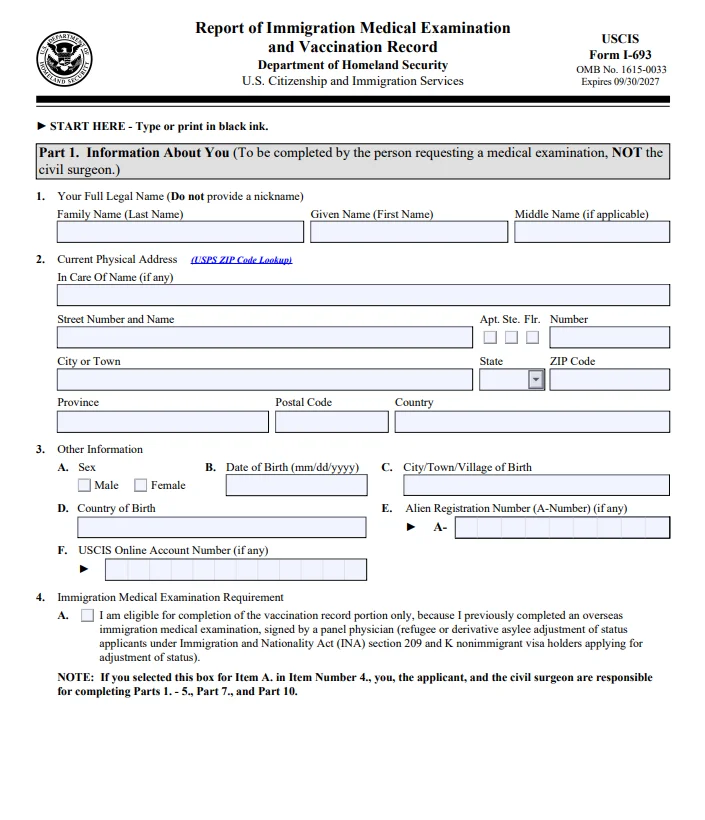
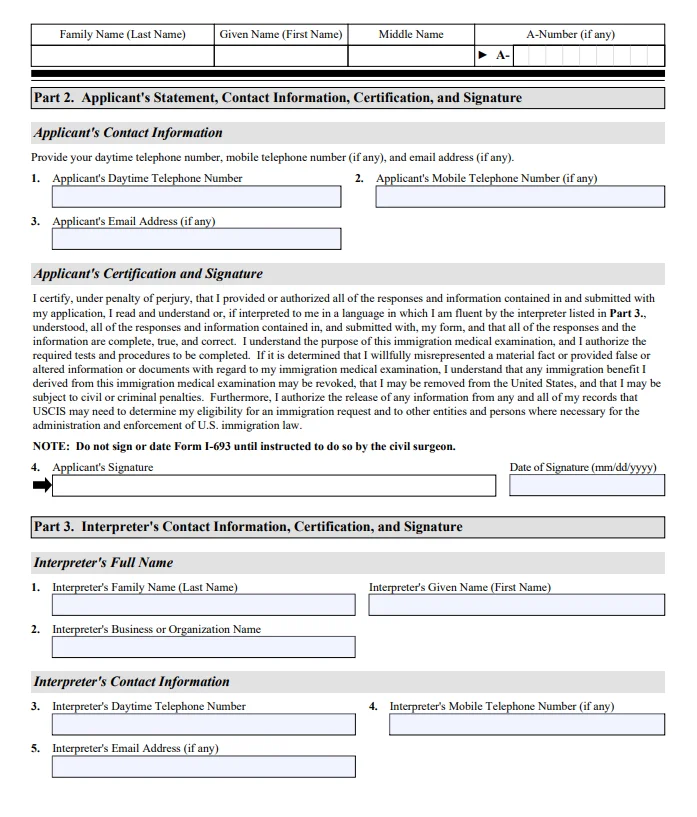
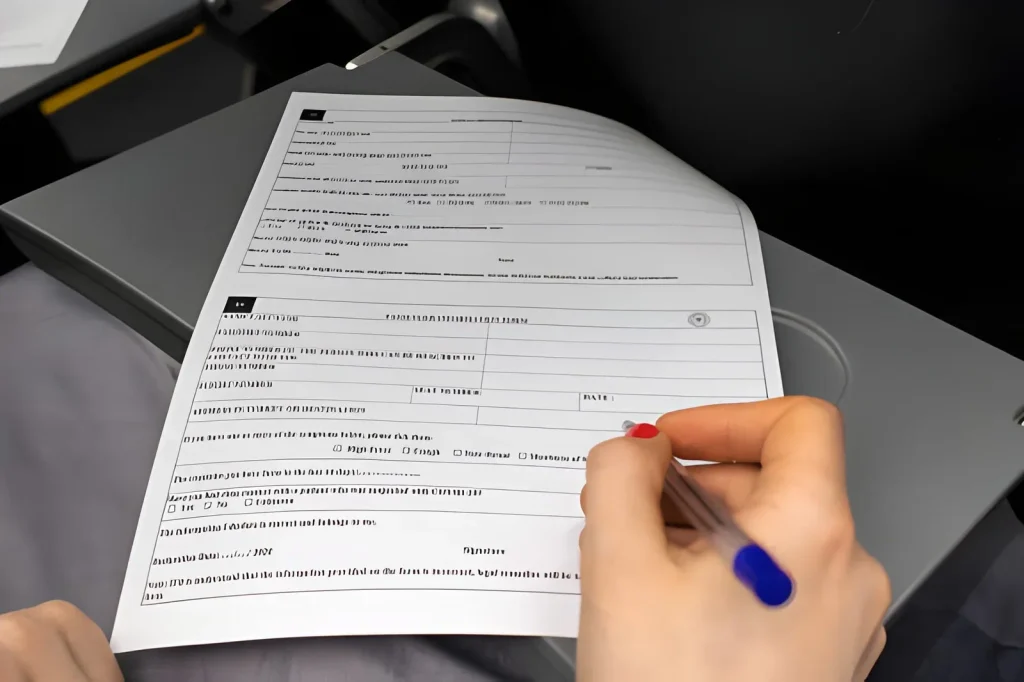
The form has multiple parts, but your responsibility as the applicant is limited to Part 1. This is the applicant information section where you fill in your legal name, date of birth, country of birth, address, and A number (Alien Registration Number) if you have one. Complete this section before your appointment so the civil surgeon can focus on the medical exam during your visit.
The civil surgeon completes every other section of the form. That includes the physical exam findings, the mental health evaluation, the vaccination record in Part 10, and the final certification with their signature and USCIS civil surgeon ID number. At Prime Healthcare of Cypress, we provide immigration physicals in Cypress and our civil surgeon completes every section of the form, reviews it for accuracy, and seals the document so it is ready for submission with your I 485.
Once complete, the civil surgeon places the form in a sealed envelope. Do not open this envelope under any circumstance. USCIS will reject any submission that shows signs of tampering or a broken seal. You submit the sealed envelope with your I 485 application by mail or bring it to your adjustment of status interview. As of December 2024, USCIS requires that you submit the form at the same time as your I 485 application. You can no longer submit it separately unless USCIS sends a Request for Evidence asking for it.
How Long Is Form I 693 Valid?
The validity rules changed on November 1, 2023. Any Form I 693 signed by a civil surgeon on or after that date is now valid only for the specific application it was submitted with. There is no separate expiration date under the new rule, but if your application is denied or withdrawn, the form becomes invalid and you need a brand new medical exam for any future filing.
For forms signed before November 1, 2023, the old two year validity rule still applies. The form must have been submitted within two years of the civil surgeon’s signature date. These older forms also become invalid if tied to a denied or withdrawn case, regardless of how recently they were signed.
The best approach is to schedule your green card medical exam in Cypress close to when you plan to file your I 485. Processing times range from 6 months to over 4 years depending on your category, so getting the exam too early serves no advantage under the current rules. If your case takes longer than expected and USCIS requests an updated form, you will need to repeat the entire exam process.
Common Mistakes That Get Your I 693 Rejected
USCIS returns thousands of forms every year because of avoidable errors. Any one of these mistakes can add months to your green card case or force you to repeat the entire medical exam from scratch. Here are the most common reasons Form I 693 gets rejected.
- Missing signatures from either the applicant in Part 1 or the civil surgeon in the certification section. Both signatures are required or USCIS will return the form without review.
- Incomplete vaccination records that do not list every required dose for the applicant’s age group. Even one missing vaccine can trigger a Request for Evidence and delay your case.
- Opened or tampered envelopes that arrive with a broken seal. USCIS treats any sign of tampering as grounds for automatic rejection.
- Using a doctor who is not a USCIS designated civil surgeon. A regular physician, even a board certified one, cannot complete this form. Only doctors listed in the USCIS Find a Doctor tool hold the designation.
- Missing lab results for the TB blood test, syphilis test, or gonorrhea test. All three must be documented on the form before the civil surgeon signs it.
- Submitting the form separately from the I 485 application. As of December 2024, USCIS requires both forms to arrive together unless they specifically request the I 693 through a Request for Evidence.
The easiest way to avoid these errors is to work with an experienced civil surgeon who reviews every section before sealing the envelope.
Frequently Asked Questions
Take The First Step
Expert aesthetic and medical care is just a click away. You deserve to look and feel your absolute best. We specialize in advanced treatments like Sculptra and Lipodissolve to help you achieve your desired results. Partner with our specialists to create a personalized care plan.